AI는 현재 전통적인 심부전 진단 도구를 지원하며 완전 자동화되고 신속하며 재현성 있는 심초음파 분석을 생성할 수 있게 해주었습니다.
심장 생체표지자(NT-proBNP 및 BNP)와 AI에 의한 ECHO 해석의 조합은 심부전에 이상적인 진단 도구입니다.
의학 AI의 발전을 통해 진단/예측 정밀도가 더욱 향상된 딥 러닝 모델을 개발할 수 있습니다.
싱가포르 국립심장센터의 선임 컨설턴트 심장전문의 겸 임상시험 및 임상시험 네트워크 수석 책임자인 Carolyn Lam 교수가 인공 지능(AI)이 현재 전통적인 심부전 진단 도구를 지원하고 정확하고 시의 적절한 진단을 제공함으로써 미래 진단 전략을 어떻게 강화할 수 있는지 공유합니다.
심부전 “환자군”은 얼마나 크고 심각합니까?
심부전은 전 세계적으로 6,400만 명 이상에게 영향을 미칩니다. 질병 부담은 엄청나며, 심부전은 노인 입원의 가장 큰 원인으로 추정 비용이 연간 미화 1080억 달러에 달합니다. 진단 지연과 치료 부족은 전 세계적으로 심부전의 높은 입원 부담에 기여합니다.
이 질병이 있는 환자들은 운동 시 숨가쁨, 쇠약, 부종과 같은 비특이 증상과 징후를 경험하기에, 심부전 진단은 어려울 수 있습니다. 호흡곤란으로 1차 진료를 받는 65세 이상 인구 6명 중 1명은 인지할 수 없는 심부전이 있는 것으로 추정됩니다.
심부전 진단에서 “희망적인 측면”은 무엇입니까?
심부전 증상은 종종 비특이적이기에, 현행 가이드라인은 심부전의 초기 진단을 위해 심초음파검사 영상검사와 함께 나트륨이뇨 펩티드 심장 생체표지자(NTproBNP/BNP) 측정을 권장하며, 이는 심장 기능 이상의 객관적 증거를 제공합니다.
나트륨 이뇨 펩티드와 심장초음파 진단 도구의 완벽한 조합을 목표로 하는 것이 중요합니다. 종종 생체표지자는 심방 세동, 고령, 신부전, 비만과 같은 동반 이환 상태의 영향을 받아 결과 해석이 어려울 수 있습니다. 심장초음파검사 역시 분석하기 어렵고 고도로 훈련된 전문가가 매우 수동적이고 시간이 많이 걸리고 오류가 발생하기 쉬운 프로세스로 이미지를 해석해야 하기 때문에 내재적 한계가 있습니다.
AI 발전은 완전 자동화되고 빠르며 재현성 있는 심초음파 분석을 생성할 수 있게 해줍니다. Madani et al(2018)은 딥 러닝 모델이 서로 다른 각도에서 심장 방을 기계로 인식하기 위해 심초음파 뷰를 빠르고 정확하게 분류할 수 있음을 보여주었습니다. Zhang et al(2018)은 뷰 확인부터 영상 분할, 방 정량화, 질병 검출에 이르기까지 심초음파 해석에 대한 개념 증명 파이프라인으로 이를 확장시켰습니다. 그 후 Ouyang et al(2020)은 인간 판독자와 유사한 편차로 좌심실 박출률의 박동-대-박동 예측이 가능함을 보여주었습니다. AI 소프트웨어가 개발됨으로써 검사당 30분이 소요되고 초음파 검사자가 250번 클릭해야 하는 매우 수동적인 절차가 단 한 번의 클릭으로 2분만에 완료되는 완전 자동화된 절차로 전환되었습니다(http://us2.ai/).
“해결 방법”- 이상적인 진단 조합은 무엇입니까?
순환 나트륨이뇨 펩티드 심장 생체표지자(NT-proBNP/BNP)와 AI에 의한 심초음파 해석의 조합은 심부전에 이상적인 진단 도구입니다.
과거에는 두 검사가 독립적으로 수행되었기에 통합 해석이 불가능했습니다. 현재는 많은 병원들이 전자 건강 기록과 사진 보관 및 통신 시스템(PACS)을 연결시켜 놓았기에 두 검사의 통합 해석이 가능합니다.
인공지능과 의사의 임상적 의사결정 기술의 시너지 활용은 심부전의 효율적이고 시기 적절한 진단을 가능하게 할 것입니다. 이는 입원과 병원 비용 감소, 대기자 명단 감소, 병원 직원과 자원의 효율적인 사용을 통해 심부전 관리의 패러다임 전환으로 이어질 것입니다.
AI에 방해가 될 수 있는 요소는 무엇입니까?
AI 사용은 심부전 진단 환경을 크게 변화시킬 수 있습니다. AI의 혜택을 극대화하기 위해 특정 요인들을 고려해야 합니다.
머신 알고리즘의 오류 위험을 최소화하기 위해 규제 검사가 필요합니다. 생물학적 다양성을 감안한 알고리즘 생성을 위해 대규모 데이터세트가 필요합니다. 이 기술의 성공을 보장하기 위해 공평한 접근, 개인정보 보호, 데이터 보안도 검토해야 할 중요한 요인입니다.
미래에는 “다양한 기회”가 있습니다.
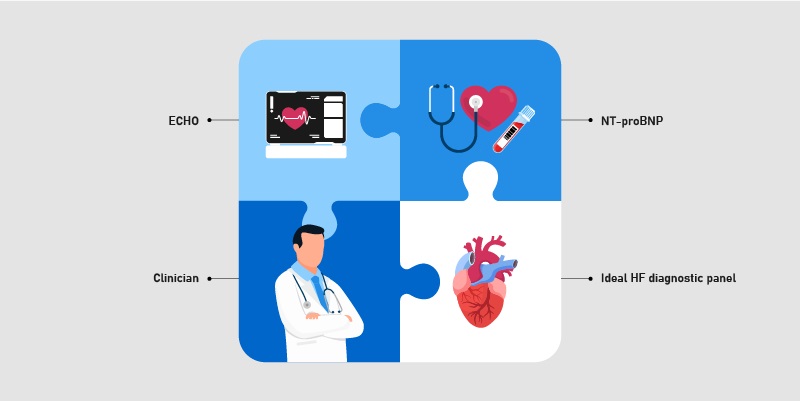
AI는 현재의 전통적인 심부전 진단 도구를 지원하는 완전 자동화되고 신속하며 재현성 있는 심초음파 분석을 생성할 수 있게 해주었습니다. 심장 생체표지자 나트륨이뇨 펩티드와 AI에 의한 심초음파 해석의 조합은 심부전에 이상적인 진단 도구이며, 인간의 임상적 의사 결정 전문지식과 함께 조화롭게 사용되어 심부전 진단을 변화시킬 것입니다(이미지 1).
이미지 1: 이상적인 HF 진단 패널을 위해 ECHO + 순환 생체표지자와 AI 조합
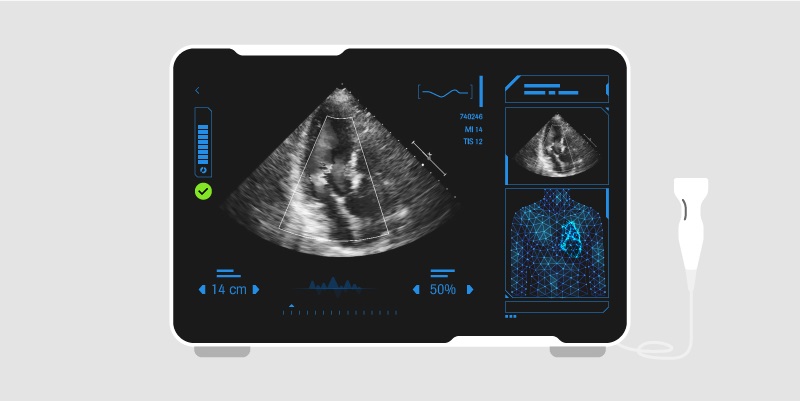
의학 AI의 발전을 통해 이제까지 달성한 것보다 향상된 진단/예측 정밀도를 위한 딥 러닝 모델을 개발할 수 있으며, 인간의 눈을 초월한 질병 패턴 인식이 가능합니다. NT-proBNP와 심초음파(휴대용 스마트 기기에 연결된 모바일 초음파 프로브 사용)의 현장 검사가 가능하기에 이러한 새로운 AI 기반 도구를 1차 진료 환경에 도입할 수 있을 것으로 예상됩니다. AI를 사용하여 심지어 훈련되지 않은 사람이 심초음파 영상을 획득할 수 있게 안내하고 몇 분 내에 완전 자동화되고 완벽하게 주석이 달린 보고서를 생성하는 것도 가능합니다(이미지 2).
이미지 2: AI 지원 심초음파. 녹색 표시등은 프로브가 올바른 위치에 배치되었음을 나타내기에 기기의 뷰 인식과 평가가 가능합니다.
AI has enabled the generation of fully automated, fast and reproducible echocardiographic analysis supporting current traditional diagnostic tools for heart failure
The combination of cardiac biomarkers NT-proBNP & BNP) and AI-enabled ECHO interpretation is the ideal diagnostic tool for heart failure
Further advancements in medical AI enable deep learning models to be developed for greater diagnostic/ predictive precision
Professor Carolyn Lam, Senior Consultant Cardiologist and Principal Lead of Clinical Trials & Trial Networks at the National Heart Centre of Singapore, shares how artificial intelligence (AI) can enhance future diagnostic strategies by aiding current traditional diagnostic tools for heart failure, delivering accurate and timely diagnosis.
How large and dark is the “cloud” of heart failure?
Heart failure affects over 64 million people worldwide. The burden of disease is tremendous, and heart failure is the top cause of hospitalizations among the elderly, with an estimated cost of USD $108 billion per year. Delayed diagnosis and under-treatment contribute to the high hospitalization burden of heart failure worldwide.
The diagnosis of heart failure can be challenging, as patients with this disease experience non-specific symptoms and signs such as shortness of breath on exertion, weakness, and oedema. It is estimated that 1 in 6 people greater than 65 years old presenting to primary care with breathlessness will have unrecognised heart failure.
What is the “Silver Lining” in the diagnosis of heart failure?
Due to heart failure symptoms often being non-specific, current guidelines recommend the measurement of Natriuretic Peptide cardiac biomarkers (NTproBNP/ BNP) in combination with cardiac imaging of echocardiography for the initial diagnosis of heart failure, which provide objective evidence of cardiac dysfunction.
The aim to perfect the combination of natriuretic peptide and echocardiography diagnostic tools is important. Often biomarkers may be influenced by comorbid conditions, such as atrial fibrillation, advanced age, renal failure and obesity making results difficult to interpret. Echocardiography too has its inherent limitations as it is difficult to analyze, requiring highly trained specialists to interpret the images in a very manual, time-consuming and error-prone process.
Advancements in AI enable the generation of fully automated, fast and reproducible echocardiographic analysis. Madani et al (2018) showed that deep learning models could enable the rapid and accurate classification of echocardiographic views for machine recognition of the chambers of the heart from different angles. Zhang et al (2018) extended this in a proof-of-concept pipeline for echocardiographic interpretation, from view identification to image segmentation, chamber quantification and disease detection. Ouyang et al (2020) then went on to show that beat-to-beat predictions of left ventricular ejection fraction could be achieved, with a variance comparable to that of human readers. AI software has been developed, turning a highly manual process that involves 30 minutes per study and requires 250 clicks by the sonographer, to a fully automated process taking only two minutes with just one click of a finger (http://us2.ai/).
“Calming the Storm”- What is the ideal diagnostic combination?
The combination of circulating Natriuretic Peptide cardiac biomarkers (NT-proBNP/ BNP) and AI-enabled echocardiographic interpretation is the ideal diagnostic tool for heart failure.
In the past, combined interpretation of these two tests was not possible since they were performed independent of each other. Currently, many hospitals have linked electronic health records and picture archiving and communication systems (PACS) which allow combined interpretation of both tests.
The synergistic use of AI and the clinical decision-making skills of physicians will enable efficient and timely diagnosis of heart failure. This will lead to reduced hospitalisation and hospital costs, reduced waiting lists, and efficient use of hospital staff and resources, a paradigm shift in the management of heart failure!
What are the possible impediments of AI?
The use of AI can drastically change the landscape of heart failure diagnosis. To maximise the benefits of AI, certain factors need to be considered.
Regulatory testing is needed to minimise the risk of errors in the machine algorithms. Huge datasets are needed in the creation of algorithms to account for biological diversity. Equitable access, data privacy and data security are also important factors to be reviewed to ensure the success of this technology.
Future has a “Rainbow of opportunities”
AI has enabled the generation of fully automated, fast and reproducible echocardiographic analysis supporting current traditional diagnostic tools for heart failure. The combination of cardiac biomarkers Natriuretic Peptides and AI-enabled echocardiographic interpretation is the ideal diagnostic tool for heart failure, working harmoniously along with human clinical decision-making expertise, which will transform the diagnosis of heart failure (Image 1).
Image 1: Combining echo + circulating biomarkers with AI for the ideal HF diagnostic panel
Further advancements in medical AI enable deep learning models to be developed for greater diagnostic/ predictive precision than ever achieved before, with recognition of patterns of disease beyond the human eye. The availability of point-of-care testing for both NT-proBNP and echocardiography (using mobile echo probes connected to handheld smart devices) can foreseeably bring these novel AI-enabled tools to the primary care setting. It is even be possible to use AI to guide an untrained person to acquire the images for echocardiography and to generate a fully automated and fully annotated report within minutes (Image 2).
Image 2: AI-assisted echocardiography. A green light indicates that the probe was placed in the correct position, allowing view recognition and assessment of the machine.
References
Ali Madani, Ramy Arnaout, Mohammad Mofrad and Rima Arnaout: npj Digital Medicine (2018) 1:6 ; doi:10.1038/s41746-017-0013-1
Ouyang D, He B, Ghrobani A, Yuan N, Ebinger J, Langlotz CP, et al 2020 Apr;580(7802):252-256. doi: 10.1038/s41586-020-2145-8. Epub 2020 Mar 25
National Heart Centre of SingaporeのSenior Consultant Cardiologist兼Principal Lead of Clinical Trials & Trial NetworksであるProf.Carolyn Lamが、現在使用されている従来の心不全診断ツールに対し、人工知能(AI)がどのように支援し、正確かつ適時に診断を行え、将来の診断戦略を補強しうるか共有します。